
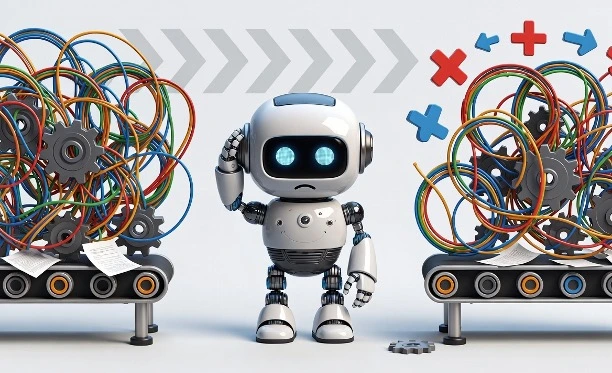
AI makes bad processes faster and more expensive.
I recently observed an organisation apply a generative AI assistant to their clunky call centre process. The result was that the first-contact resolution rates dropped (yay!), but escalations rose (boo!). As escalations were escalated to senior staff for resolution, the cost to the business was much higher than before, and overall call time with customers was longer, especially while waiting for senior staff to pick up. This example isn’t too dissimilar to many others, especially given the growing number of AI pilots.
Why AI in services is failing quietly
AI solutions are prevalent in service-related processes with the hope of reducing high labour costs. Many AI pilots are undertaken in contact centres, shared services, and ITSM, but very few prove the ROI. In a recent study by Qualtrics, they reported that “AI-powered customer service fails at four times the rate of other tasks”.
In many cases, the adoption of AI has increased costs for organisations due to the creation of technical debt. The perception is that these functions consist of standard and repeatable processes - processes that seem easily automated. In reality, processes are often convoluted, inconsistent and highly manual. The time and effort to understand the intricacies of the processes, where the variabilities and bottlenecks occur, are often sidelined and jump to designing the AI solution.
The result is that AI solutions are too often designed around a best-case scenario rather than all the what-ifs that make processes complex. Most organisations are trying to automate opaque and fragmented processes. AI just hides the mess behind a slick interface for people to address later.
Processes are not a side project to AI
Being clear on the current state of your processes is a necessary step. I’m not talking about process mapping just for documentation’s sake, but rather understanding:
- what is value-adding and non-value-adding (handoffs, queues, manual steps) exist in your processes;
- scenarios that can result in process variations;
- and demand patterns.
Without a clear definition of where value and non-value effort exists in your processes, you have nothing solid for AI to “optimise”. Instead, you risk AI automating non-value-add in processes.
For example, a customer calling about a billing dispute could be kept in an endless loop from an AI IVR that fails to determine the appropriate menu options. Alternatively, a voicebot insists on handling everything, fails to interpret the nature of the call and gives generic “check your app” advice.
The naysayers will say, “Why spend time understanding the current state of processes when the new, flashy AI solution will replace them?” Well, I say, yes, it will replace something, but what will it replace, and how do you know it’s removing non-value-add? Ultimately, the ROI of AI is still dependent on first having a base understanding of the problem you’re trying to solve, otherwise you risk not prioritising the right thing to improve with AI.
First simplify, then digitise, then automate
Michael Hammer and James A. Champy, way back in 1993, set the scene with these prescient words: “Automating a mess yields an automated mess” (Hammer M., & Champy J. (1993). Reengineering the Corporation: A Manifesto for Business Revolution).
This simple, but effective rule of thumb also applies to AI:
1. Simplify
This is the first key step that’s too often missed. Spend some effort understanding where the non-value-add and complexity exist in your processes.
Reduce friction in your processes! Common signs of this include duplicate steps (e.g., approvals), unnecessary checks, rework loops, excessive batching, manual, non-system steps, and branching that results in process variations.
Thereafter;
- Measure the consequence of the non-value-add and complexity, i.e. time and cost to your organisation.
- Prioritise those improvements based on the biggest bang for your buck and not the loudest voice in the room.
- Redesign the process to eliminate non-value-added activities and reduce complexity.
- Derive a standardised process that creates a consistent method for how work is done to make it predictable.
2. Digitise
In my experience, it’s seldom systems and tools that create bottlenecks, but people. The more a process relies on people to make decisions, convert data, and communicate, the greater the risk of variation and delay due to human error. That’s not to say that people don’t add value to processes. Customers often like to seek advice from someone on a call before making a buying decision. However, many of the other steps of the processes are transactional, such as processing an order and can be digitised.
For AI not to just shift bottlenecks from one part of your process to another, it’s important to encompass the end-to-end process -both standardised and digitised. After all, AI can only automate based on system actions. To be fair, I’m not considering actions outside of systems that AI could apply through robotics. I’ll leave that topic for another day.
3. Then automate/augment
AI, at least at the time of writing, has strong use cases for automating routing, triage, summarisation, and data retrieval. Furthermore, AI’s ability to predict based on data is advancing every day, only limited by the information it has access to. All these use cases require AI to be built on top of both a simplified and digitised flow. In doing so, the postmortem of realising the ROI can be easily traced back to whether the non-value-add and complexities have been eliminated.
An example of going through these stages is: Simplify stage - Current-state encompassed 10 variants of handling a customer complaint, different templates, and multiple teams. By redesigning and standardising the process to eliminate non-value-add activities and complexity, it was reduced to 3 standard paths, a single owner, and clear SLAs. Digitise stage – Customer processes are digitised end-to-end in a single system, eliminating the need for other disparate systems and manual, non-system steps. Automate stage - AI assistant automatically picks up customer enquiries, drafts responses and suggests next actions against those 3 paths.
Practical “Lean‑Before‑AI” Playbook
Regardless of where you’re at in your AI journey, there are some immediate steps you can take to ensure you set your organisation up for success.
- Run a rapid value‑stream mapping workshop on one problematic process (e.g., “client onboarding”); ask “what is truly adding value or not in your process?”, “is there rework happening and why (root-causes)?”, “What causes different variations?”
- Quantify the problems in your process; ask “how much effort and cost are created from the problems?” “What percentage of this could be eliminated with improvements?”
- Create a simple ideal-state standard process codified in systems so AI has clean process for use cases. Prioritise use cases based on eliminating quantified problem(s) in the process.
- Pilot AI only where the process is already stable (e.g., summarising calls, classifying requests, routing tasks between teams).
In short, if the process isn’t stable, it’s not ready for AI.
High‑performing service organisations won’t be ‘AI‑first’ or ‘Lean‑first’ – they’ll be Lean‑powered AI organisations. Get the work flowing, then let AI help it flow even better.
Zen Consulting helps organisations realise value in digital transformations. We support you in understanding your “why” in technology investments so you can deliver successfully the “how” and “what”. To find more information contact us or email us directly hello@zenconsulting.co.nz.
How can Zen Consulting help?
We provide: